
Verditex Showcases Precision Agriculture Solutions at J-AGRI Kyushu 2026 in Japan
How precision agriculture is helping farmers do more with less
Farming has never been easy, but the pressures facing those in agriculture are on the rise. Farmers across the developed world are all grappling with the same structural challenge: an ageing workforce, rising input costs, and plots of land that need to be worked more efficiently than ever before.
The situation in Japan illustrates the scale of the problem. The country’s core farming population has fallen from 2.4 million in 2000 to around 1.1 million today, and the average farmer is now 69 years old.
The combined pressures of workforce contraction, fragmented smallholder plots, and the rising cost of inputs are shared by farming communities across the globe. The question facing the industry is how to maintain and ideally improve productivity with fewer hands. The need to find technology-led solutions is urgent.
This is exactly the problem that smart, precision agriculture is designed to address. It gives farmers the tools they need to work more accurately, reducing waste, cutting overlap, and maximizing the productive use of every acre.
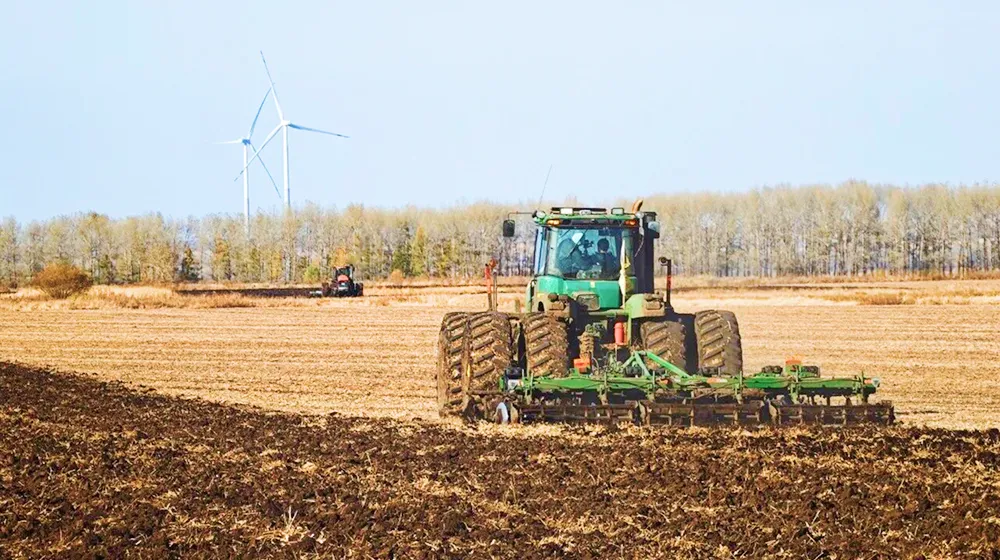
At the heart of precision agriculture is positioning. Ploughing, planting, spraying, and harvesting all depend on accurate coordinate information. When a tractor or transplanter can follow a centimeter-precise path, the benefits compound quickly. It leads to less seed wastage, reduced chemical application, fuel savings from eliminating unnecessary passes, and higher yields from the same land.
This level of accuracy is made possible by global navigation satellite system (GNSS) technologies, combined with real-time kinematic (RTK) correction signals that refine raw satellite positioning.
Modern precision agriculture systems powered by GNSS support a wide spectrum of field operations, from auto-steer tractors and precision planters to smart sprayers, combine harvesters, RTK mapping drones, and autonomous field robots. As these technologies become more accessible and easier to integrate into existing machinery fleets, adoption is accelerating.
According to The Report Cube, Japan’s smart agriculture market was valued at $1.34 billion in 2025 and is projected to reach $4.09 billion by 2034, reflecting both the depth of need and the pace at which practical solutions are reaching the field.
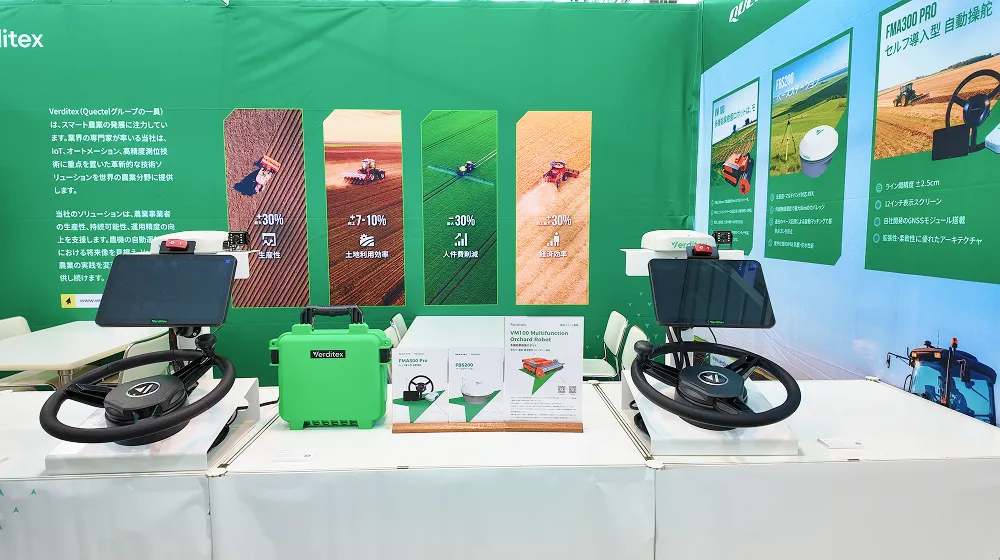
Verditex at J-AGRI Kyushu 2026
In late May 2026 Verditex, a smart agriculture brand of Quectel Group, participated in J-AGRI Kyushu 2026, one of Japan’s leading regional agricultural technology exhibitions. Kyushu is absolutely key to Japan’s food needs, producing roughly 20% of the country’s agricultural output.
The event brought together farmers, distributors, and cooperative advisors from across Kyushu to explore the latest precision farming tools and innovations. Verditex showcased its flagship precision farming solutions, the FMA 300 and 300 Pro Auto Steering System and the FBS 200 Base Station.
The FMA 300 and 300 Pro deliver ultra precise GNSS-guided auto steering across a wide range of agricultural machinery, improving accuracy during transplanting, spraying, and harvesting by minimizing row overlap and missed passes. Paired with the FBS 200 Base Station, which provides high-accuracy RTK corrections, the two products form a complete precision positioning system ready for immediate field deployment.
At the show, Verditex engineers worked directly with farmers on questions about integrating the systems into existing machinery, and with cooperative advisors exploring performance across the fragmented, smallholder plots that are common across Kyushu’s farming landscape.
The technology foundation of GNSS and IoT
Behind Verditex sits Quectel Group’s global expertise in IoT, GNSS, and cellular technology. Quectel’s GNSS solutions power the full spectrum of modern agricultural applications, from auto-steer systems to precision planters, smart sprayers, fertilizer spreaders, land-levelling systems, and soil-sampling platforms.
Recent technological innovations provide access to high-accuracy positioning that was once confined to large-scale commercial operations. For the smallholder farmer managing fragmented plots, or the cooperative looking to standardize technology across its membership, that shift matters enormously.
As labor shortages deepen and the economics of farming tighten further, precision agriculture will move from competitive advantage to operational necessity. The technology to make that transition is here and it is getting more capable, more affordable, and easier to deploy with every passing season.
Learn which GNSS technologies are shaping the next generation of precision agriculture devices and enhancing productivity in smart farming. Download the Quectel guide here.
About Verditex
Verditex, part of the Quectel Group, is dedicated to advancing smart agriculture. Led by industry experts, we provide innovative technology solutions to the global farming sector, with a strong focus on IoT, automation and high-precision positioning technologies.
Our solutions empower agricultural businesses to improve productivity, sustainability, and operational precision. With a clear vision to shape the future of smart agriculture, Verditex is committed to delivering advanced technologies that transform farming practices worldwide.
Media Contact:
For interviews or more information, please contact:
Email: marketing@verditex.com
Website: www.verditex.com


